Why Logan Driveways Crack (And How to Build One That Lasts)
Stop driveway cracks with a durable concrete driveway built for Logan conditions. Choose a concreter Logan for expert advice and…

Most Logan driveways crack because the reactive clay under them swells after storms and shrinks through dry spells. A slab built without a compacted sub-base, enough steel and proper drainage cannot ride that movement. Reactive clay is a soil that swells when it takes on water and shrinks as it dries, moving whatever sits on top of it.
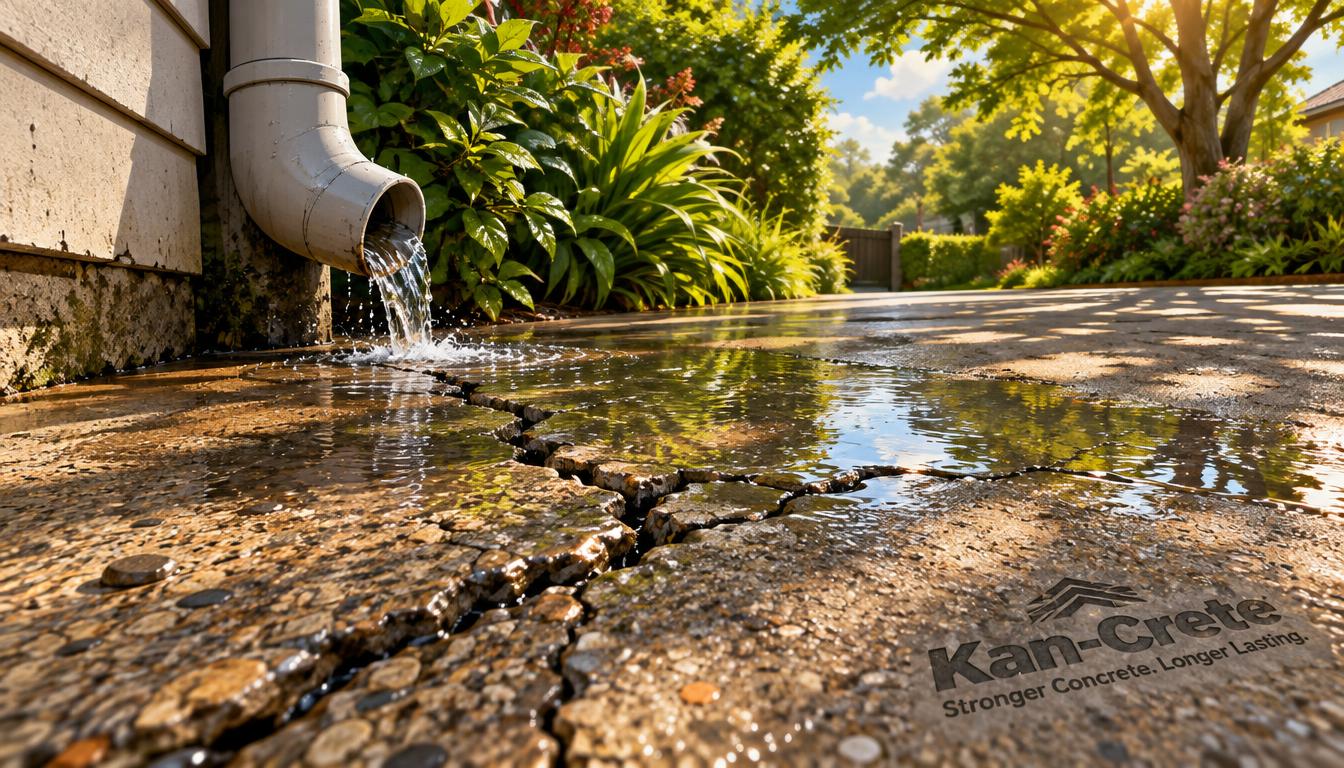
A Daisy Hill owner once showed Tony a driveway poured only six years earlier. The crack began at the corner where a downpipe emptied beside the slab every time it rained, and the concrete itself was sound.
Two culprits wreck a driveway here: moving clay and water allowed to pool or soak beside the slab. Three build decisions beat them: a compacted sub-base, reinforcing mesh in a slab thick enough for your vehicles, and control joints with falls that move water away. A driveway that cracked within a few years almost never failed because of the mix; it failed because of what sat under it and around it.
That is the difference a concreter Logan homeowners rely on makes to the life of a home driveway. Before you pay for any repair, walk the driveway after the next heavy rain and note where water sits. That puddle is usually where the crack started.
Logan sits on reactive clay. Almost 40% of driveway failures across Queensland come down to that soil moving under the slab, not anything wrong with the concrete itself. Your neighbour’s driveway may be fine because it sits on a better base or sheds water sooner.
Logan’s hot summers and heavy storm rain drive a swell-shrink cycle that stresses the slab, its joints and its edges every year. All concrete can show hairline cracking as temperatures change. Clay movement is what turns a hairline into a step.
The clay takes on water through summer storms, swells, and heaves the slab upward. Through a dry winter it shrinks and pulls away, so the slab loses support at the edges and corners first. That is why so many cracks run from a corner or along an edge.
A large tree within a few metres of the driveway makes this worse on one side. Its roots dry the clay through winter, and that side sinks while the other stays put. A one-sided sink beside a big gum is common on older blocks where slabs were poured years before the tree grew.
Water left to sit beside a slab does more damage in five years than every car that drives across it.
The site clues sit in plain view once you know where to look. Walk the driveways and lawns on your block after rain and check these five things:
Clay movement only becomes a crack when the build gave it an easy path. A slab poured thin over uncompacted fill flexes the first time a loaded ute parks on a soft corner. No reinforcing mesh, or mesh left lying on the ground instead of in the middle of the slab, means nothing holds the crack tight once it opens.
Skipped control joints are the third shortcut. Concrete shrinks as it cures and must crack somewhere, so without joints the slab picks its own line. Concrete work like this looks the same as good work on pour day, and the difference shows up years later.
Mark each clue you find with a chalk cross on the slab. A concreter who sees three crosses along one edge can usually tell you the cause in a minute.
Run a 20-cent coin along the crack. If it will not drop in and both sides are level, you are probably looking at shrinkage. If the coin disappears, or the edge catches your shoe, the ground under the slab has moved.
A crack wider than about 3 mm, or one where one side sits higher than the other, points to movement under the slab, not a surface fault. A hairline under about 1 mm with level sides is usually shrinkage and cosmetic. A corner or edge that has dropped so water runs toward the house or garage is a drainage and sub-base problem.
| Crack type | What it looks like | Likely cause | What it means for you |
|---|---|---|---|
| Hairline surface crack | Under 1 mm, both sides level | Shrinkage during curing | Cosmetic, seal and watch |
| Map or crazing cracks | Fine network across the surface | Surface dried too fast in heat | Cosmetic unless spalling |
| Straight crack wider than 3 mm | Runs across the slab, no control joint nearby | Slab movement | Needs assessment |
| Stepped crack | One side higher than the other | Clay heave or sub-base sinking | Structural |
| Dropped corner or edge | Slab tilts, water runs the wrong way | Washed-out or uncompacted sub-base | Rebuild of that section |
One crack type fools people every year. A crack that opens in winter and closes again in summer is the clay breathing under the slab, and sealing it does nothing. It opens again next dry season, however neat the job looks.
Potholes, erosion and patches that sink or lift belong on the same list of signs that it is time to redo your driveway. Photograph each serious crack with a ruler beside it, then again in three months. A crack that is still growing rules out any cosmetic fix.
A patch sits on top of the problem. A Logan driveway that cracked because the clay moved will crack again along the same line, no matter how well the filler is applied. The force that opened the crack keeps working underneath.
A filler or overlay bonds only to the surface, so it cannot fix an unstable sub-base, a drainage fault or ongoing clay movement. The patch usually cracks along the old line within a season or two. A slab that has moved cannot be patched back to new.
Resurfacing with a bonded compound is a different story on a sound slab. Fine cracks, stains and surface wear on level, well-drained concrete suit it well. Four cases cover most Logan driveways:
An overlay on a slab that still moves fails worse than the original. Instead of cracking in a line, it delaminates in sheets, and the new concrete peels off the old in plates. That is money with no value left in it.
Fixing a poorly built driveway usually means breaking out the old slabs and paying for a full repour. Concrete work that lasts is priced on what goes in the ground, because that is where the life of any concreting job sits. If a repair quote does not mention the sub-base or where the water goes, it is a cosmetic job and should be priced like one.
A driveway that outlasts Logan clay is built from the ground up. That means 75-100 mm of compacted road base, a 100 mm slab of 25 MPa concrete with SL72 mesh on chairs, and control joints every 2.5-3 m. A fall then sends water to the street rather than along the slab edge.
Proper base prep, reinforcement and correctly placed control joints greatly reduce the chance of serious cracking. Skip any one of them and the other two cannot make up for it. The quality of a concrete driveway project is decided before the truck arrives.
Site preparation starts by stripping topsoil, roots and any old fill down to firm natural ground. The concreting crew compacts that subgrade, then places road base in layers and runs a plate compactor over each one. The finished base should feel like a road under your boots.
A poorly compacted sub-base gives itself away. Footprints sink into it, loose gravel rolls on top, and one corner sits lower after a night of rain. Those are materials you should refuse to pour on.
A 100 mm slab suits cars and vehicles under about 3 tonnes, and 125-150 mm carries trailers, boats, trucks or a caravan. Residential concrete in Australia is usually 25 MPa, with 32 MPa common under exposed aggregate. Mesh grade and base depth step up with the load.
| Element | Light vehicles (cars, SUVs) | Heavy loads (trailers, trucks, caravans) | Why it matters |
|---|---|---|---|
| Slab thickness | 100 mm | 125-150 mm | Carries the wheel load without flexing |
| Concrete strength | 25 MPa | 32 MPa | Resists cracking and surface wear |
| Reinforcing mesh | SL72 on chairs | SL82 or thicker on chairs | Holds a crack tight if one forms |
| Sub-base | 75-100 mm compacted road base | 100-150 mm compacted road base | Spreads load and stops the slab sinking |
| Edge thickening | Same as slab | Thickened edge beam | Protects the most exposed part on clay |
Mesh lying on the ground when the pour starts is the single most common hidden fault. The reinforcing mesh belongs on bar chairs in the upper half of the slab, with about 40-50 mm of cover. Ask to see the chairs before the truck arrives.
Control joints go in every 2.5-3 m on a 100 mm slab and are cut to about a quarter of its depth. They also run from garage corners and re-entrant angles, the points where cracks start on their own. A joint there gives the slab a neat place to crack instead of a random one.
A fall of about 1 in 100 away from the house carries storm water across the slab and out to the street. Without it, water tracks along the slab edge and soaks the clay there. Walk the site on pour morning and check three things: the road base is firm underfoot, the mesh sits on chairs, and the joint positions are marked.
None of this can be fixed once the concrete is down. A good crew will welcome the walk-through, because it costs them nothing and saves a callback.
On a flat Logan driveway a broom-finished plain or coloured slab does the job. The moment there is a slope or a shaded, wet patch, exposed aggregate earns its higher price with grip. Which finish suits you comes down to how wet and how steep the driveway gets.
A smooth steel-trowelled coloured driveway on a slope becomes dangerous in Logan storm rain, so any slope should get a broom finish or exposed aggregate. A broom finish drags fine lines across the surface and stays grippy when wet. Of the three main finishes, exposed aggregate is washed back to show the stone and grips best of all.
| Finish | Grip when wet | Look | Price tier | Best for |
|---|---|---|---|---|
| Plain grey broom finish | Good | Clean and simple | Lowest | Flat driveways, sheds, budget builds |
| Coloured concrete | Good with broom finish, lower if steel trowelled smooth | Range of tones to match the house | Middle | Street-facing driveways where kerb appeal matters |
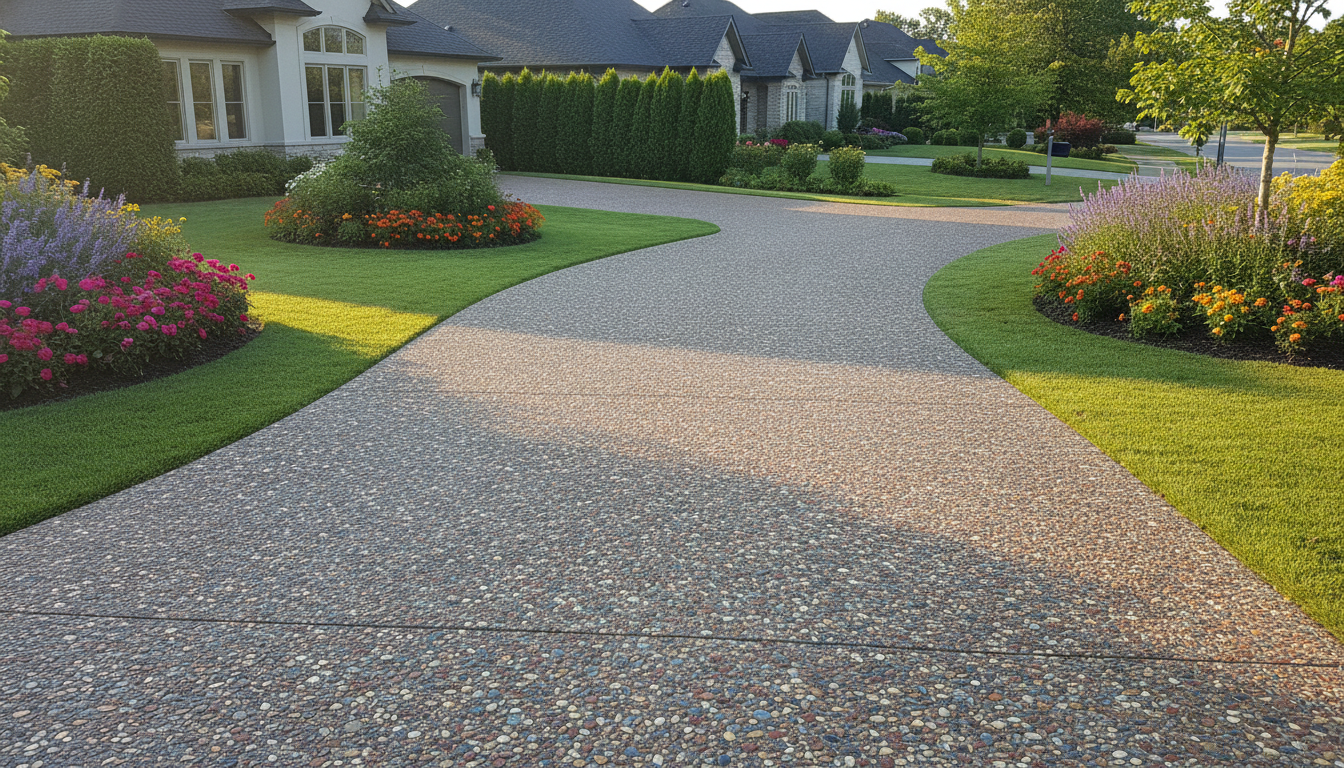
| Exposed aggregate | Best | Natural stone texture | Highest | Slopes, wet areas, pool surrounds, premium street frontage |
| Stencilled or stamped | Varies with the pattern and sealer | Paver or stone look | Middle to high | Feature areas and entries |
Coloured concrete gets its tone from pigment through the mix or a colour hardener worked into the surface. A sealer goes on to hold the colour. The range of tones runs from warm sands to charcoal, so you can match the house, the roof or the fence.
Aggregate size and stone colour are chosen before the pour and cannot be changed afterward. Once the stones are in the mix, your options are set for the life of the slab. Price follows the finish: plain grey sits lowest, coloured in the middle and exposed aggregate at the top.
Kerb appeal on day one is easy; the look two summers later is the real test. Ask to see a finished driveway of the same finish that is at least two summers old. That is how the colour and texture will really look on your place.
Everything from your property boundary to the kerb belongs to the council. A new or replaced crossover in Logan needs a council permit before it is poured, while the driveway on your own land usually does not. Logan City Council sets the level at the boundary, and every other level works back from it.
A new crossover that does not match the council level can be ordered removed at your cost, so the permit is cheaper than the argument. The crossover sits in the council road reserve and is built to council’s specification for thickness, width and gradient. A like-for-like replacement inside your boundary needs no permit in most cases.
The concreter usually lodges the crossover application, with the details of the concrete work attached. Some owners lodge it themselves to save a fee. Either way, nothing is dug until the permit is in hand.
Once the boundary level is fixed, the concreter runs string lines from it back to the garage slab. Levels are set so water flows away from the garage and house, never toward them. The same rule applies to driveways on every block, from Slacks Creek to the acreage suburbs.
A garage that sits lower than the street makes the project harder. The fix is a drain grate across the entry, or a regraded transition that lifts the driveway before it drops to the door. Confirm in writing who is applying for the crossover permit, you or the concreter, before the start date is booked.
A concreter you can trust will tell you, before quoting, how deep the road base will be, how thick the slab is, what mesh goes in and where the joints fall. Every one of those numbers goes in writing. A price over the phone with none of them is a guess.
In Queensland a QBCC licence is required for concreting work valued over $3,300, and you can check the number on the QBCC online register. QBCC is the Queensland Building and Construction Commission, the state building regulator. A company that cannot give you a number to check should not pour your driveway.
Five checks separate concreters who build to the full spec from those who do not:
Clear communication on these five points before the quote usually means clear communication on pour day. A concreter who dodges one of them will dodge others later.
The best concreter in Logan for your job is the one whose driveways poured several years ago on clay blocks are still level. Concreter Logan reviews are worth reading for mentions of turning up on time, matching the quote and work still looking right after a few seasons. Star counts alone tell you little about the ground.
A drive past a finished job tells you more than any photo. Look for level edges, water marks that stop at the street, and joints with no stray cracks beside them. Local concreting services that have worked the same suburbs for years can name streets for you to visit.
A cheap concreter in Logan nearly always saves the money in the ground where you cannot see it. Thinner road base, mesh laid on the dirt and no joints trim the price on paper. The fault shows up two or three summers later as stepped cracks and dropped corners.
Ask what happens if the excavation hits soft fill or an old slab. A team that has worked Logan clay will have a price and a method ready for that. One that has not will stop and renegotiate with the truck already booked.
Quality in concreting services shows up on the delivery docket as much as on the surface. Keep the itemised quote and compare it against the docket from the concrete supplier on pour day. The docket shows the strength grade and volume you actually received.
The area of the driveway sets the base of the price. The thickness, the finish, the old concrete that has to come out and how close the truck can get move it from there. Concreter Logan cost depends mostly on six items and on the state of the ground under the old slab.
Going from a 100 mm slab to 125-150 mm for trailers or trucks raises the concrete volume by a quarter to a half for the same area. Breaking out and removing the old driveway, cutting the crossover and extra excavation into fill are separate line items on a quote. A quote without them is not finished.
The six cost drivers on any Logan quote are:
A long driveway with narrow side access often costs more per square metre than a short wide one. The concrete has to be pumped or barrowed through the space beside the house, so mention access when you book the quote. Open areas where the truck backs straight in are the cheapest to pour.
A reliable figure only comes from a site visit and measure, never a phone estimate. Get free quotes from more than one concreter and compare the line items, not just the total. Measure the driveway length and width and note the heaviest vehicle before you ask for a free quote, so the measure-up confirms a number for your budget instead of starting from scratch.
You can walk on the new slab after 24-48 hours and park a car after 5-7 days. A loaded trailer or caravan should wait closer to a month. Concrete reaches its design strength for heavy use over roughly 7-28 days, so patience in the first weeks pays off for years.
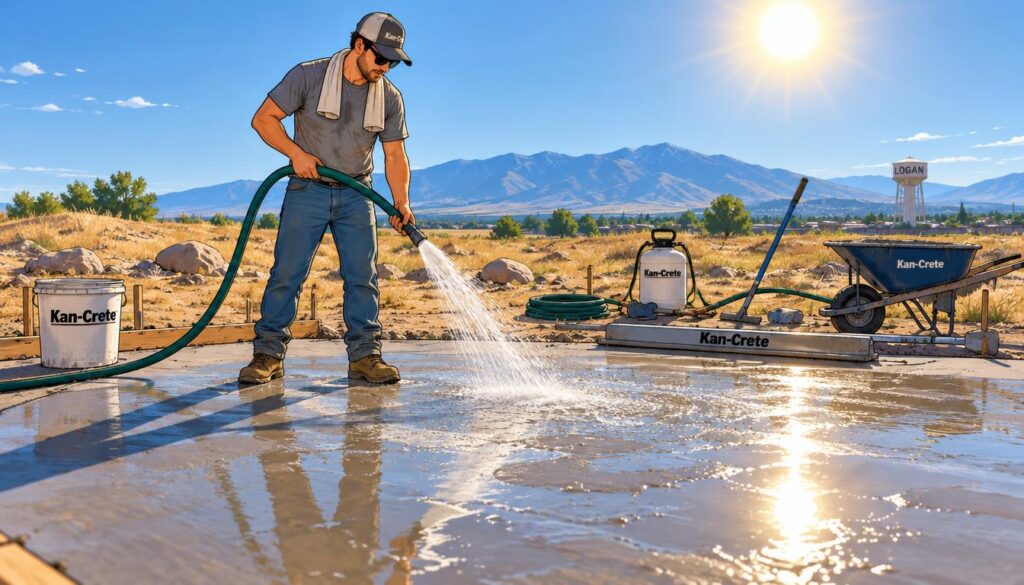
In Logan summer heat the surface must be kept damp or covered for the first few days, or it dries too fast and crazes. New concrete gains strength through a chemical reaction that needs water. A slab that bakes dry today loses strength it never gets back.
Keep all foot traffic off the slab for the first day. From day two you can walk on it, but keep the dog, the kids and the bikes off the edges, which stay soft longest. A paw print set into the surface is permanent.
Hose the surface lightly in the morning and afternoon, or leave it under plastic or hessian. In a heatwave the concreter may spray a curing compound instead. Either way, the aim is a slow dry over the first week.
A car can park after 5-7 days at the earliest. A loaded ute, trailer or caravan needs longer because its wheel load sits on a smaller patch of young concrete. Give those vehicles time, two to four weeks depending on the weight.
Turning the steering wheel while the car is stopped scuffs a young surface. The tyre twists on one spot and tears the top layer, leaving a dull patch. Roll forward a little as you turn for the first month.
Hose off leaf tannin, bird droppings and oil as soon as you see them. The longer they sit, the deeper they soak into the surface. Coloured concrete and exposed aggregate should be resealed every 2-3 years to guard against fading, staining and water soaking in.
A pressure washer held close on exposed aggregate pops the stones out. Hold the wand back and use a fan tip. Keep garden beds and mulch below the slab edge so water does not sit against the concrete through the life of the driveway.
Redirect any new downpipe or garden tap away from the driveway. Water that drips beside the slab every day does the same slow damage it did to the old one. Put the reseal date in your calendar two years out, because a worn sealer is invisible until the first oil stain refuses to lift.
Kan-Crete works out of Shailer Park and pours driveways and slabs across Logan, Brisbane Southside and the northern Gold Coast. The site visit is a short drive rather than a special trip. The office is at 3 Roselea Street, Shailer Park QLD 4128.
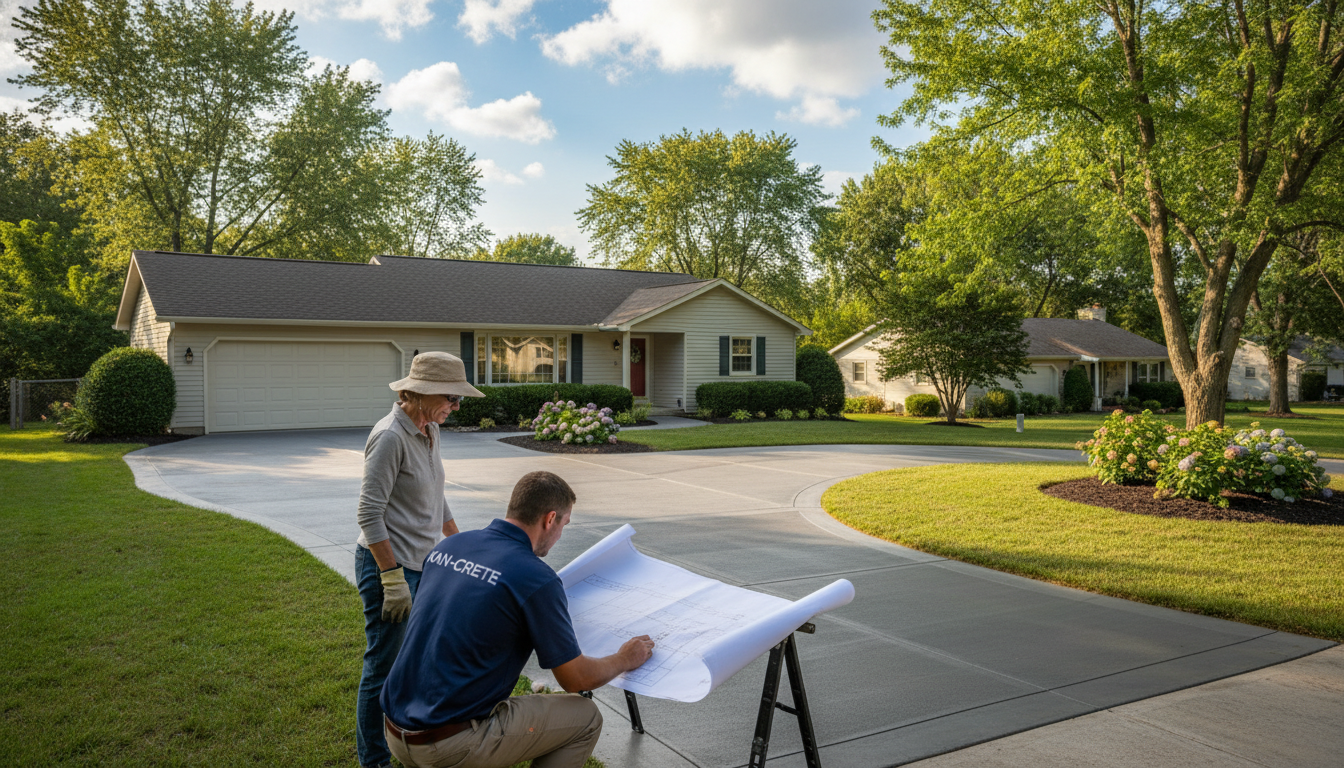
Every job starts with a site walk, a measure-up and a written quote that names the layers, and ends with job-specific care advice before the crew leaves. The same crew handles the crossover and the driveway, so levels and permits stay with one team. Concreting services across Logan cover Shailer Park, Daisy Hill, Slacks Creek and Logan Central.
The services the team pours include:
Concreters in Brisbane Southside deal with the same reactive clay and storm runoff as Logan. The Shailer Park team works Southside suburbs such as Sunnybank and the northern Gold Coast on the same build approach. A Brisbane concreter based on the Southside is close enough to Logan to do the site walk the same week.
Tight side access, sloping blocks and acreage driveways are the norm in Logan, so say so on the first call and the quote allows for them from the start.
Local concreting comes down to knowing the ground, and this crew has lifted enough old slabs here to know what usually sits under them. Call Tony on 0405 721 873 for the free on-site measure and quote, or email kan-crete@outlook.com. Have the photos of your cracks, the rough measurements and the heaviest vehicle in mind when you call, and the quote will cover the real job at your home.
A driveway on Logan clay lasts when it is built to ride the ground rather than fight it. The base, the steel and the drainage are decided before the first truck arrives. The clay will move no matter what, so a concrete driveway survives only on a compacted sub-base with steel in the right place and water sent to the street.
A patch over a moving slab buys a season, not a decade. Homeowners who spend once on the job done properly stop spending on fillers every winter. Quality in the ground is the only kind that still shows at your home in twenty years.
Walk your driveway after the next storm and note where the water sits. Then call Tony on 0405 721 873 to have the site measured and quoted properly.


© Kan-Crete | All Rights Reserved.