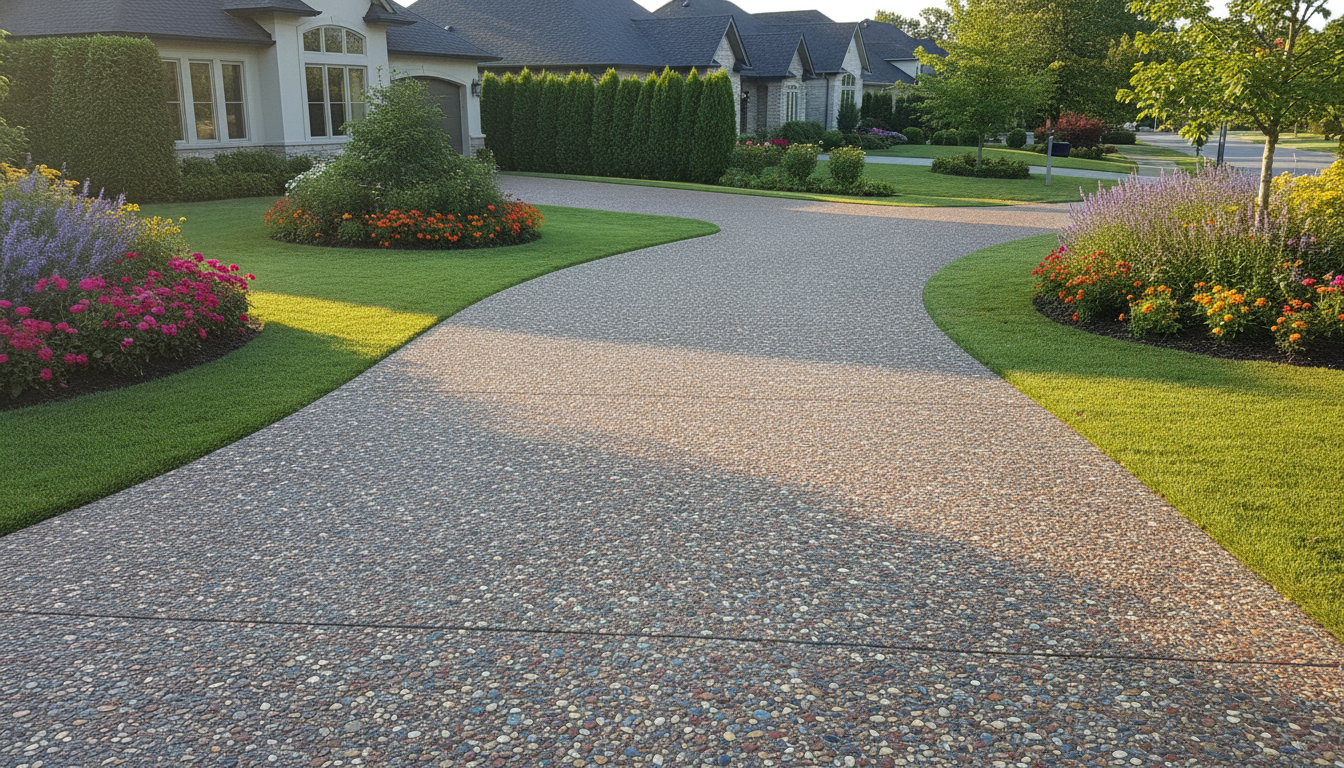
The Cost vs. Value Guide: Exposed Aggregate Driveways in Logan
When Sarah’s old driveway began cracking, every trip to the house felt like a reminder of a job left unfinished.…

If your driveway in Logan is cracking or sinking, the problem is often hidden beneath the surface. A smooth finish might cover it up for a bit. But it won’t stop the underlying issues.
Logan’s clay soils expand when it rains and shrink when it’s dry. This constant change can cause your driveway to lift, drop, and crack. A skilled concreter in Logan will look at the ground conditions, not just the surface.
In this guide, you’ll learn how to spot problems early and find the right solution. You’ll see why quick fixes often don’t last. And when it’s time to call in an expert to prevent more damage.
If you need advice before spending money, call Tony on 0405 721 873. He’s a local Logan concreting specialist who can offer site-specific guidance.
If your driveway in Logan is cracking or dipping, it’s often the ground below, not the concrete. Almost 40% of driveway failures in Queensland are due to reactive soil movement. A driveway might look fine but fail if the base keeps shifting.
Getting it right starts with understanding your site conditions and water flow. A top-rated logan concreter will look beyond the surface. This way, you avoid repeating the same repair.
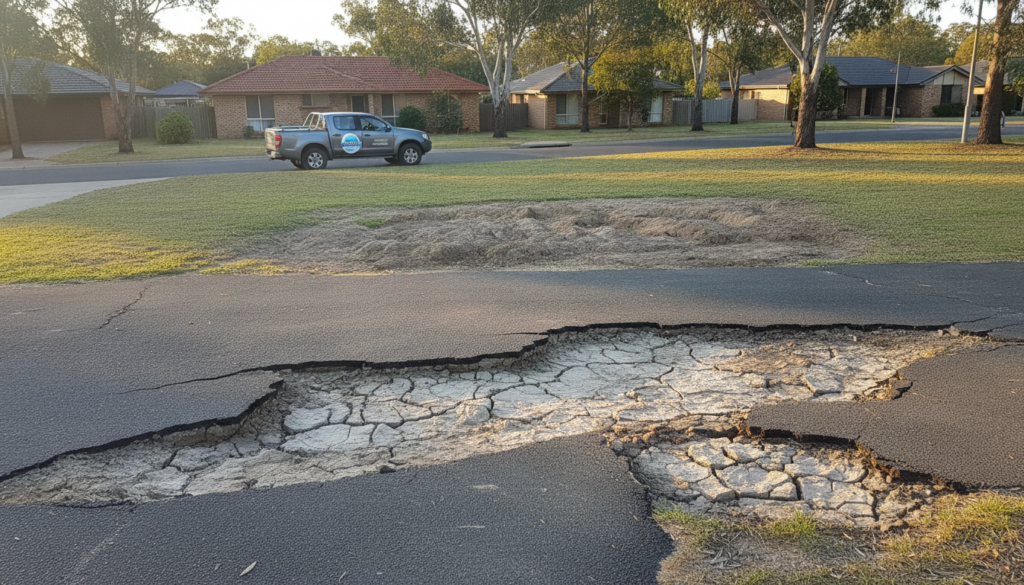
Logan’s reactive clay expands when wet and shrinks when dry. This cycle of shrink and swell creates ongoing movement under the slab. Over time, it puts stress on the concrete, joints, and edges.
Moisture changes, like near garden beds or downpipes, can cause the slab to twist. Even strong concrete can crack if the support underneath is uneven.
Small clues often show up before a big break. Look for step cracking or cracks that open up after dry spells. You might also notice joints widening as the slab shifts.
Pay close attention around the garage entry and the street crossover. Uneven edges, “dishing” where tyres track, and ponding water after rain can point to base movement and drainage trouble.
| What you notice | What it can mean underneath | Why it matters |
|---|---|---|
| Step cracking or cracks that widen in dry weather | Clay shrinkage and slab bending between support points | Cracks can keep reopening as the ground cycles wet to dry |
| Widening joints near the garage entry | Localised settlement from moisture change or poor compaction | Edges can drop and create a trip hazard or scrape vehicles |
| Uneven lip at the street crossover | Wash-out, drainage run-off, or movement at the boundary | Water can track under the slab and speed up erosion |
| Dishing in wheel paths | Base softening or pumping under repeated loading | Tyres concentrate weight, which can worsen deflection and cracking |
| Ponding water after rain | Low spots from settlement or poor fall to drainage | Standing water feeds the shrink–swell cycle and stains the surface |
Surface patching can hide a crack, but it doesn’t fix sub-base instability, drainage problems, or the shrink–swell cycle. If water still ponds or runs under the edges, the movement usually returns. Then the patch pops, the crack reflects through, or a new crack forms nearby.
Durability comes from matching the repair to how your soil behaves and how water moves across the site. If you’re weighing options, this quality concrete services guide is a useful starting point for understanding what to check in Logan conditions.
When you choose quality concrete services that consider drainage, joints, and base support, the fix is far more likely to hold through Logan’s wet summers and dry spells.
If your driveway is cracking or sinking, don’t rush to fix it. A proper diagnosis can save you from unnecessary costs. The experts in Logan start by looking at the underlying causes, not just the surface damage.
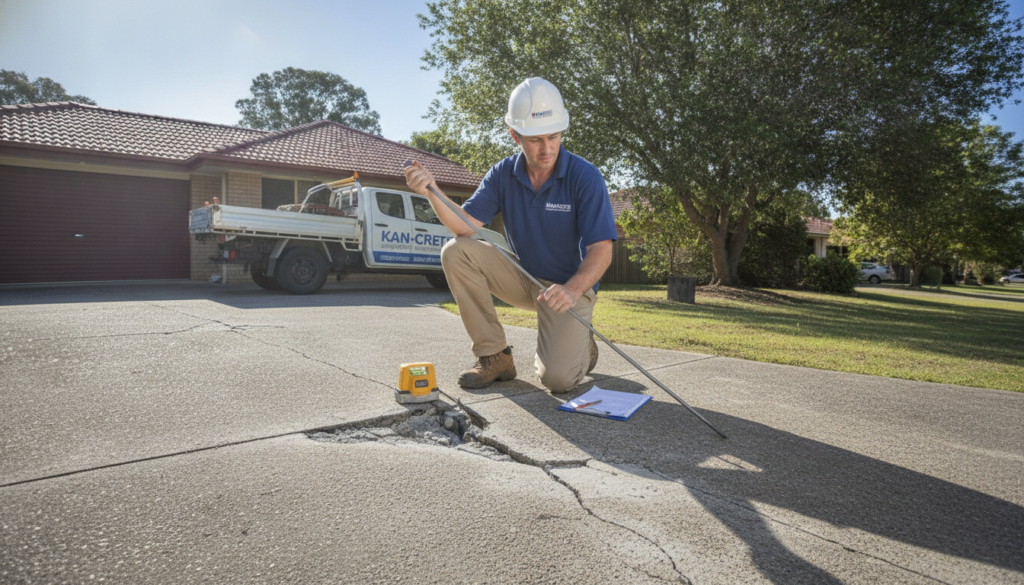
First, identify the type of cracking. Small hairline cracks might be cosmetic if the slab is still level. But step cracks, widening gaps, or uneven sides suggest deeper structural issues that need a different approach.
Next, check if water is getting under the slab. Look for pooling after rain, downpipes near the driveway, and runoff tracks. These signs can lead to moisture buildup and base shifting on reactive clay soils.
Also, assess if the base has failed. Soft edges, rocking near the garage, and settlement at transitions suggest erosion or poor compaction. Nearby trees and dense gardens can also affect the slab’s movement due to roots and soil moisture changes.
| What you notice | What it can suggest | What to check on site |
|---|---|---|
| Fine hairline cracking with no level change | Surface shrinkage or minor curing stress | Crack width, pattern, and whether it changes after rain |
| Step crack or one panel higher than the next | Slab movement from reactive soil or base settlement | Use a straight edge, check joints, note any rocking underfoot |
| Water pooling or staining in one zone | Drainage concentration feeding moisture under the slab | Downpipe discharge points, roof runoff paths, slope direction |
| Soft edges or crumbling near sides | Edge undermining, washout, or weak support | Probe for soft spots, inspect garden borders, check for voids |
| Sinking near garage, crossover, or joins | Base failure at transitions or traffic load stress | Look for settlement lines, tyre paths, and cracked joint seals |
| Cracking closer to trees or thick planting | Root influence and uneven moisture draw in the soil | Distance to trunks, root zones, and how often the area is watered |
Experts in Logan take a careful approach to diagnosing driveway issues. They consider topography, soil type, moisture, drainage, vegetation, and access. This detailed assessment ensures the repair method is tailored to the specific conditions, avoiding unnecessary costs.
Before fixing a cracked or sunken driveway, it’s good to understand your block’s soil. In Logan, small changes in soil moisture can cause reactive clay to move. A concreter in Logan will first check how water, shade, and foot traffic affect the ground.
Clay-rich ground can be identified with a few simple checks. When wet, the soil feels sticky and heavy. It may also “grab” your shoes.
When it dries, clay turns hard and brick-like, with tight surface cracking. Clay holds water well because its particles pack tightly and drain slowly. The largest clay particle is more than 1,000 times smaller than the smallest sand particle.
| What you notice on site | What it often means | How it can show up in a driveway |
|---|---|---|
| Soil sticks to boots and smears when wet | High clay content with strong plastic behaviour | Edges lift or settle as moisture changes under the slab |
| Ground goes very hard in dry weeks and feels tight underfoot | Clay shrinkage and surface tension cracking | Random cracking or widening joints during dry spells |
| Water sits in low spots after rain | Slow drainage and poor infiltration | Soft base zones that lead to rocking, dipping, or pumping |
| Fine mud tracks and silty puddles near the driveway | Erosion and migration of fines under runoff | Voids under the slab and uneven settlement over time |
Some blocks are more prone to soil movement. Runoff along driveway edges can erode the base, causing problems. Downpipes that discharge near the driveway can also cause issues if water soaks into the subgrade.
Vegetation plays a role too. Tree roots and dense garden beds can change the moisture balance, affecting the slab edges. A professional concreting company will consider these factors before recommending a fix.
It’s often thought that mixing sand into clay will “open it up”. But soil scientist Linda Brewer from Oregon State University’s College of Agricultural Sciences says, “No amount of sand added to clay soil will change its texture.” This matches what you see on reactive sites.
When sand is mixed into clay, the blend can become more stubborn. Brewer compares rototilling sand into clay to a potter’s wheel, as it can align and strengthen clay particles. A concreter in Logan and a professional concreting company will usually focus on moisture control, drainage paths, and a stable base rather than quick soil “recipes”.
Your driveway might look rough for many reasons. The fix should match what’s happening underneath. Check if the crack has a height difference and if water is getting under the slab. This often points to affordable concreting solutions that last through Logan’s wet and dry swings.
When deciding on a repair, consider safety, drainage, and how close the damage is to the garage threshold. If unsure, the best concreter in Logan will focus on the cause and movement first, not just the surface.
Crack repair is suitable for fine, narrow cracks that stay flat. It works well for slabs that aren’t holding water and show no signs of base washout at the edges.
In reactive clay areas, a flexible sealant can handle small seasonal shifts better than hard fillers. Watch the same spots after big rain and then a dry spell, as movement patterns are key, not just a one-day snapshot.
If a corner has dropped or a low spot is ponding water, lifting or re-levelling might be the best choice. It can also protect the garage threshold by restoring fall away from the house.
Levelling works best when the cause is handled first. Fixing drainage paths and base support before correcting the height stops the same area sinking again. This is where affordable concreting solutions deliver the most value.
Replacement is wise when cracking is widespread, levels keep changing, or the base has failed and won’t stabilise. Patching can lead to repeat spending with the same problems returning each season.
A rebuild lets you reset the job with engineered base preparation suited to reactive clay, plus the right falls for water shedding. If you want a clear scope and fewer surprises, the best concreter in Logan will map the distress areas, check drainage lines, and match the repair to what your slab is doing over time.
| What you notice | What it often means | Best-fit approach | Practical outcome you get |
|---|---|---|---|
| Hairline cracks with a flat surface | Minor shrinkage or light movement without a level change | Crack sealing with a flexible product and monitoring | Less water entry and slower crack growth |
| A crack you can feel as a step | Local settlement or edge drop creating a trip hazard | Re-levelling after drainage and base support are addressed | Safer walking line and smoother vehicle access |
| Low spot that holds water after rain | Poor fall, local sinking, or loss of support under the slab | Lift or rebuild the affected area once runoff is controlled | Better water shedding and less moisture cycling under the slab |
| Many cracks in different directions across the bay | Ongoing movement or broader base failure | Full replacement with engineered base preparation | More reliable performance through wet/dry seasons |
| Damage near the garage threshold | Risk of water tracking toward the house and undermining edges | Targeted re-levelling or replacement, based on stability | Improved protection at the doorway line and cleaner drainage |
In Logan, your driveway’s strength depends on the ground beneath it. If the base softens or shifts with the weather, even good concrete can crack. That’s why experts focus on preparing the sub-base before laying concrete.
Compaction turns loose material into a solid base. It improves load-bearing strength and reduces settlement. This is crucial for clay, which shrinks and swells with the weather.
Quality concrete services use a controlled build-up of layers. Each layer is compacted before adding the next. This method prevents voids that can cause collapse later.
| Base step | What you’re aiming for | What tends to go wrong on reactive clay |
|---|---|---|
| Strip and proof the subgrade | Remove soft spots and shape a stable working surface | Hidden wet pockets pump under load and start slab rocking |
| Place sub-base in thin lifts | Even layers that compact through the full depth | Thick dumps compact on top but stay loose underneath |
| Compact with the right equipment | Dense, interlocked particles that resist rutting | Under-compaction leaves voids that settle after rain |
| Keep levels consistent | Uniform support so the slab isn’t bridging low areas | Low spots collect water and soften the base over time |
Clay moves most when moisture swings are sharp. You need to avoid trapped water under the slab and keep moisture steady around the edges. Make sure downpipes and drainage lines don’t dump water beside the driveway.
Focus on the slab edges. Uneven drying can cause the ground to heave and shrink. Logan concrete specialists ensure consistent falls and stable outlets to prevent saturation.
Some amendments can improve clay, but they work slowly. Gypsum can help clay particles clump together over time. Organic amendments like compost can also improve structure gradually.
Soil scientist Linda Brewer suggests spreading two to three inches of organic matter on top of soil surfaces. This slows evaporation and reduces hardening. She notes that building soil takes repeated additions at least annually, and “the soil will remain clay — forever.”
Remember nutrient tie-up when using organic matter. As it breaks down, microbes can temporarily lock up nitrogen. Use wood chips in autumn, small top-ups in spring, and an organic fertiliser to balance this. Manure is higher in nitrogen, so it suits times when roots are actively growing; in wet periods, autumn applications can wash away before spring.
Be cautious of big claims from spray-on aerators and instant chemical solutions. Brewer warns that these promises can be overstated. While a surfactant may help water soak into dry clay, it’s not a reset button for a moving base. For driveway performance, quality concrete services still rely on sound compaction and stable moisture conditions.
Water is often the main cause of a sinking driveway on Logan’s reactive clay. Rainwater seeps into the base, softening it and washing away fine material. This can lead to cracks over time.
Good drainage is key before pouring concrete. With logan concreting services, ensure the driveway has the right falls. This keeps water away from your garage and house edge.
“Correct falls” mean the driveway is graded to prevent water pooling. You should see runoff flow to a safe edge, not sit in a dish near the garage door or along a control joint. Even small puddles can signal a dip that will worsen as the base gets wet.
An expert concrete contractor will also look at where downpipes, garden beds, and taps send water. If those sources spill onto the driveway, you can end up with a wet edge that pumps the base during traffic, after storms.
On sloped blocks, fast runoff can concentrate into a narrow path and scour the base. You want to slow it down, spread it out, or capture it before it cuts under the slab. That can mean reshaping edges, adding a grated channel, or directing water to a stable discharge point.
In heavy rainfall, or where runoff can’t be avoided, subsurface drainage systems can help by diverting water to stormwater infrastructure. This reduces saturation beneath the slab and helps keep the subgrade more consistent through wet and dry spells. Many logan concreting services will assess these flow paths early, not after damage shows up.
Drainage and discharge points can be shaped by Logan City Council expectations, specially near the kerb and crossover. If falls are set the wrong way, you may face rework when it’s time to connect to lawful stormwater routes. Planning this upfront helps you avoid cutting into new concrete later.
An expert concrete contractor can align the driveway grade, surface drainage, and any subsurface drainage systems so they work together. That way, you manage ponding, protect the base, and keep runoff moving where it’s meant to go.
| Drainage focus | What you check on your driveway | What it helps prevent on reactive clay | Common approach during concrete planning |
|---|---|---|---|
| Ponding control | Puddles after rain near the garage, joints, or mid-slab | Base saturation, pumping under tyres, early cracking | Set consistent falls away from buildings and remove low spots before the pour |
| Runoff on sloped sites | Water racing down one side and cutting along an edge | Erosion under the slab, edge drop, uneven settlement | Use surface capture like channels and shape edges to slow and redirect flow |
| Subsurface moisture control | Wet patches that linger, soft ground beside the driveway | Swell–shrink cycles, loss of support beneath the slab | Install subsurface drainage systems to intercept seepage and reduce saturation |
| Compliance and discharge | Where water exits near the kerb, crossover, or stormwater point | Rework risks, poor falls, water diverted under the driveway | Confirm lawful discharge and set levels early to suit Logan City Council expectations |
In Logan, the small details are crucial. Concrete changes with heat and moisture, and the ground can shift. This is why controlling cracks is not just about using stronger concrete. It’s about smart joint placement, the right reinforcement, and the slab’s thickness.
Expansion joints act as planned release points. Without them, cracks appear randomly. With proper spacing and clean lines, cracks are more likely to occur where expected. A professional concreting company will place joints based on your driveway’s shape and stress points.
Reinforcement mesh helps distribute loads and reduces crack risk. It’s most important where cars brake or turn. Quality services ensure mesh is correctly supported during pouring.
Thickness is key, too, on softer or reactive areas. A thin slab flexes more, increasing cracking risk. The right thickness matches loads, width, and subgrade stability. Proper thickness from a professional company means better stiffness and load transfer.
| Detail | Common failure point | What works better on reactive clay | Where you notice the benefit |
|---|---|---|---|
| Expansion joints | No joints or poor spacing, leading to uncontrolled cracking | Joint lines planned to guide movement and reduce jagged cracks | Cleaner crack pattern and neater edges at turns and long runs |
| Control joints (saw cuts) | Late or shallow cuts that don’t “activate” before the slab cracks | Timely cutting at suitable depth to create a weak plane by design | Fewer surprise cracks across the middle of the driveway |
| Reinforcement mesh | Mesh lying low or bunched up, giving uneven support | Mesh positioned and supported so it stays centred through the pour | Better load sharing where wheels track, brake, and pivot |
| Slab thickness | Too thin for site conditions, causing flex and early cracking | Thickness matched to vehicle loads and variable ground stiffness | Less movement under cars, specially near the crossover and edges |
| Curing time | Traffic too soon, leading to scuffs, micro-cracks, and weak surface | Protected curing so moisture stays in and strength builds evenly | Harder-wearing surface and fewer early-life defects |
Curing is not just a finishing touch. Early traffic can wear the surface and cause small cracks. Quality services ensure proper curing, allowing the slab to handle Logan’s weather and ground movement.
Council rules can affect your driveway plan before you start. In Logan, any work near the verge or crossover needs approval. A skilled concreter can help avoid last-minute changes.
Changes to the crossover, kerb line, or verge level need extra checks. Even small changes can affect pedestrian access and stormwater flow. Skipping these steps can cause delays, rework, or compliance issues later.
| Common driveway work | Where it happens | Why Council may get involved | Typical risk if missed |
|---|---|---|---|
| New or widened crossover | Verge and kerb line | Protects footpath access, sight lines, and assets | Removal and rebuild at your cost |
| Lowering or reshaping the verge | Nature strip near the road | Stops water diversion onto neighbours or the roadway | Drainage complaints and compliance action |
| Replacing a sunken slab near the boundary | Front setback and street interface | Controls levels, grades, and safe transitions | Ponding at the crossover and premature cracking |
| Adding a channel drain at the garage entry | Driveway-to-house junction | Ensures lawful discharge and prevents nuisance flows | Water ingress and surface failure in storms |
Drainage is crucial because heavy rain can cause runoff. Your driveway must have the right falls to prevent water damage. Logan concrete specialists plan for this, ensuring water is discharged legally.
Good drainage design also prevents wear and tear. Water under slabs can cause damage, leading to cracks and uneven surfaces. This is why proper drainage is essential.
Local knowledge makes paperwork easier. A concreter familiar with Logan’s conditions can spot potential issues early. This avoids costly changes later.
Logan concrete specialists view compliance as a way to manage risks. Handling approvals and standards upfront saves you from costly rework.
Your driveway should stay level and safe, not just look good at first. A skilled concreter in Logan starts by carefully examining the site. This is because small ground changes can lead to big repair costs later on.
True craftsmanship in concrete work starts long before the first truck arrives. It begins with a detailed study of the site’s natural characteristics and soil behavior.
Your assessor should walk the whole area and check the topography. They look at where stormwater runs, where it slows, and where it can pool near slab edges.
They also examine vegetation. Trees, hedges, and garden beds can cause uneven moisture. This might mean clearing or using a root barrier strategy to protect the perimeter.
Reactive clay needs special checks. They look for signs of movement, local soft spots, and past drainage issues. This helps set the sub-base depth, compaction method, and water control to suit your block.
| What gets checked | What you might notice on site | What it changes in the build |
|---|---|---|
| Topography and runoff paths | Low points, ponding after rain, water tracking to the garage | Grading plan, falls, and drainage placement to move water away fast |
| Vegetation and roots | Lifted edges near trees, dry gaps in summer, soggy zones in shade | Root barrier approach, edge detailing, and moisture control around the slab |
| Soil behaviour on reactive clay | Recurring cracks, rocking slabs, sinking corners, uneven joints | Sub-base depth, compaction sequence, and drainage details to manage movement |
Quality concrete services give clear quotes. They should detail base preparation, reinforcement, joint layout, and curing time. This way, you know exactly what you’re paying for.
Delivery is as important as the mix. You should see workmanship focused on durability, safe falls for drainage, and compliance. This means avoiding a quick finish that hides problems.
Call an expert concrete contractor when cracks keep coming back, even after patching. Sinking edges, water pooling, and doors or gates starting to bind can also point to ongoing ground movement.
If you’re seeing those signs, treat it as a site issue, not surface wear. A proper assessment helps you avoid repeating the same repair on the same reactive clay conditions.
Your driveway finish is key to your home’s look. It also affects how it handles storms, heat, and daily use. When getting quotes for concreting in Logan, ask about the best finish for your home, not just the look.
Plain concrete is simple and practical. It’s great for family homes where you want a clean look without spending too much. It’s also easy to match if you need to extend the slab later.
Exposed aggregate costs more but offers a textured surface. This helps with grip in wet weather and hides dust and stains better than smooth finishes. This means you might not need to clean it as often.
| Finish option | What you’ll notice day to day | Cost and care expectations |
|---|---|---|
| Plain concrete | Smoother underfoot, neat and uniform, easier to hose down after mowing | Usually lower upfront spend; may show stains and tyre scuffs sooner; sealing can help |
| Exposed aggregate | More texture for traction, premium street appeal, better at disguising dirt and wear | Higher upfront spend; needs a good wash routine; sealing helps protect colour and reduces grime build-up |
| Coloured or tinted finishes | Can soften glare and tie in with brick and roof tones, with less “plain grey” look | Added material cost; colour consistency relies on good batching and curing practices |
In Queensland, the finish you choose affects comfort and safety. Smooth slabs can be slippery when algae builds up. Textured finishes are safer in heavy rain.
Colour is also important. Darker tones absorb more heat, which is a problem near entry paths and where kids walk barefoot. A good concreter will discuss shade, slope, and water flow before choosing a finish.
Looking for affordable concreting? Consider the whole project, not just the cost per square metre. The total cost depends on slab size, thickness, access, excavation depth, base prep, and drainage needs.
To avoid unexpected costs, ensure your quote includes all details. A top concreter will explain site prep and disposal clearly. Many will also provide a detailed breakdown so you can compare services fairly.
On Logan’s reactive clay, your driveway moves with moisture changes. You can’t change the soil, but you can limit water and edge drying. These are the main causes of repeat cracking.
Stay on top of small issues before they become big problems. If you’ve used a professional concreting company for repairs or a new pour, good upkeep protects your investment. It keeps the slab working as planned.
Keep the surface functional each month. Sweep off leaves, soil, and grass clippings. This stops them from holding moisture, staining the finish, or creating dams that push water toward joints and edges.
Clean the driveway at least twice a year. Use a mild detergent and a pressure washer on a low setting, then rinse well. This lifts grime and tyre marks without roughening the surface or opening up the paste.
Seal every two to three years to slow down water and chemical uptake. Sealing also reduces surface wear, which helps your driveway shed water instead of soaking it in. If you’re unsure which sealer suits your finish, ask a professional concreting company that offers quality concrete services and understands local conditions.
Inspect at least once a year, after wet spells or long dry periods. Hairline cracks can turn into channels that feed moisture into the sub-base. Early crack repair is often quick and tidy, and it supports the long-term results you expect from quality concrete services.
| Task | How often | What you do | Why it matters on reactive clay |
|---|---|---|---|
| Debris removal | Monthly | Sweep leaves, dirt, and grass; clear around joints and edges | Stops water damming at edges and reduces staining and slip risk |
| Deep clean | Twice a year | Mild detergent, low-pressure wash, thorough rinse | Removes grime that holds moisture and exposes small defects early |
| Seal the surface | Every 2–3 years | Apply a suitable concrete sealer after cleaning and drying | Creates a barrier against water, salts, and oils that can weaken the surface |
| Crack inspection | Annually | Check joints, edges, and wheel paths; note widening or spalling | Finds early pathways for moisture to reach the sub-base |
| Minor crack repair | As soon as found | Repair small cracks before they grow or collect grit | Limits moisture-driven sub-base changes that lead to further movement |
If you notice repeated cracking in the same line, widening gaps at control joints, or soft spots near edges, treat it as a moisture control problem, not just a cosmetic one. A professional concreting company can check drainage, sealing wear, and joint condition. This ensures your routine maintenance matches the reactive clay reality and supports quality concrete services over the long haul.
If your driveway is cracking or sinking in Logan, the main problem is often reactive clay. This clay swells when wet and shrinks when dry. This movement puts stress on the slab. To fix it, you need to start with a stable base and good drainage, not just patching the surface.
You now know what to do. First, find out why the problem is happening. Look for things like water flow, poor slopes, nearby trees, and sloped blocks. Then, pick the best solution, make the base stable, and ensure the concrete is the right thickness and cured properly.
It’s also important to check with Logan City Council early, for things like crossovers and drainage rules. This can save you from costly rework, non-compliance, and delays. A skilled concreter in Logan will warn you about these issues before starting, and concrete specialists can help you avoid common mistakes.
If you need specific advice or a quote, call Tony on 0405 721 873. You’ll get practical advice tailored to your situation. It will be based on your block, drainage, and what works in Logan’s soils, from a local concreter backed by specialists.


© Kan-Crete | All Rights Reserved.